The Market Estate is a typical 1960s construction made up of 271 flats and maisonettes and built on the site of the Metropolitan Cattle Market, near Caledonian Road in London. Although the last person only moved out this week, it has been going to rack and ruin for years. The flats, boarded up with metal shutters to prevent squatters, look bleak and dreary so that one might think the scheduled demolition is not a minute too soon.
But all is not what it seems. A group of seventy five artists have been working feverishly in a race against the demolition crews. They have turned many of the old flats into installations, beacons of colour and light amidst the drab exterior of the complex. On closer inspection, you can see things are afoot. Outside the buildings in the huge open spaces you can see various objects, such as a large shell like structure made out of ninety salvaged doors one still labeled “Jim’s Room”. Painted bicycle tracks and football impressions speak of activities the children were banned from. In a broader sense, they remind us that this bleak complex was once alive. Where are all the children now?
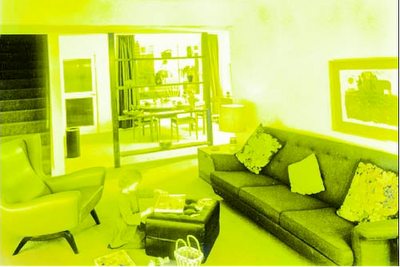
As I said earlier, the last tenants moved out just last week . One of those tenants dropped in to see how things were going only to find her former flat completely decked out in fluorescent green, down to the cups of tea laid out on the table (above). “Its mad” was all she could say. “We chose the colour because it seems carcinogenic and nuclear, which relates back to the ‘60s theme” says Gadi Sprukt who came up with the idea.
“I approached the Southern Housing Group which owns the estate . I expected to be confronted with a den of bureaucrats but my contact, Stephen Ross, was surprisingly open to it.” Along with other sponsors, Higgins Construction and HTA Architects Ltd, the housing association stumped up £20,000 for it, and with an additional £5,000 from the Arts Council, Sprukt and his team were able to get the ball rolling.
The estate will be open to the public for one day only, the sixth of March. Its good to see that despite the recession companies will still make money available to the arts. Recession? what recession?
