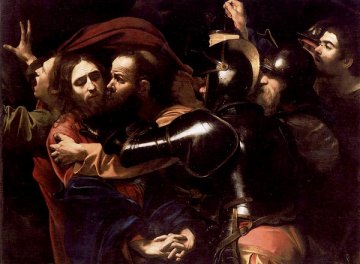
“It took someone as volatile and unpredictable as Caravaggio to truly capture the betrayal of Christ. His masterpiece continues to speak through the ages”
“The prisoner is submissive, sorrowful. His hands are joined together in a passive gesture of faith. He is making no attempt to defend himself, or even to push away his betrayer. As he endures the treacherous kiss, he looks downwards, too appalled to glance at the traitor. He does not wish to accuse or to question. The man who kisses him appears frenzied, sweat shines on his skin. His desperation is reflected in the brute paw of his hand as it grabs at its prey. The three soldiers of the Roman army stand close. One of them forces his gauntleted hand upwards, close to the captive’s throat.”
Although born in Milan, he took the name Caravaggio after a town in Lombardy where he had been sent at five years of age in order to escape plague ridden Milan.
His greatest work the Taking of Christ (1602) described above has a core theme of betrayal and is as poignant this Good Friday as it ever was. If you wish to see the painting, the bad news is that it is currently on loan from the National Gallery of Ireland to the Scuderie del Quirinale in Rome.
