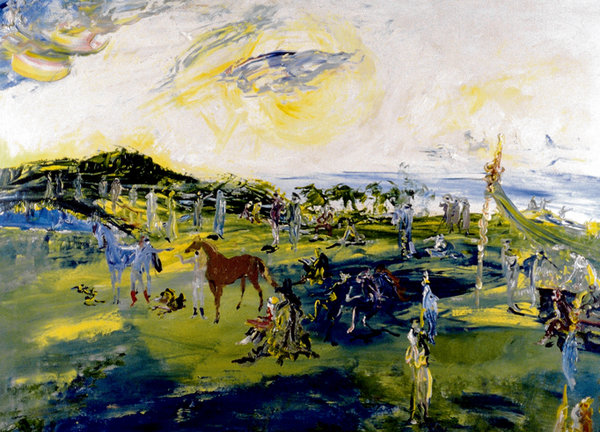
Very few people can be unaware of the major crisis in the banking sector. The bankers themselves are the butt of public ire as the sums of money required to bail them out are off the monopoly scale. It would seem that we, our children and even our grand children will be paying for the mess the banks have created. So what has all this to do with art? Well it is a fact not generally known that one of the main culprits Allied Irish Bank has since the early eighties being acquiring an incredible art collection. Since we are all paying to bail them out, is it not fair that the public should have access to this art? AIB should make their extensive collection available for viewing by the public instead of the select few who grace the corporate halls and corridors of AIB.
When they embarked on the path of acquiring art for its premises, it decided it would take a coherent approach rather than randomly picking up pieces. They decided to do one thing in their approach to collecting art. That one thing was to represent the entire history of Irish modernism, roughly from 1890 to the present. In this respect they were far more foresighted in their policy of collecting art than they would be proven to be at actual banking. In the early eighties, Irish art was hugely undervalued and underappreciated.
Writing in The Irish Times last week, Fintan O Toole had this to say about the collection
“There are at least two superb Jack Yeats paintings. Now or Never (1929) is one of Yeats’s most energetic and takes on a favourite subject – horse racing. A Race in Hy Brazil , meanwhile, is a bona fide masterpiece, suffused with mysterious light and mythic gaiety. Samuel Beckett was so struck by it that he compared it (rightly) to Watteau’s L’Embarquement pour Cythere .
Among the earlier works, Roderic O’Connor’s Red Rocks near Pont-Aven is a superb example of his barely restrained wildness and Aloysius O’Kelly’s Corpus Christi Procession (1880) earns its keep as one of the first Irish paintings that can accurately be called Impressionist.
There are top-class examples of the work of the three big figures of post-war Irish art: Louis Le Brocquy, Patrick Collins and Tony O’Malley. The Le Brocquys include the Picasso-influenced early work Irish Tinkers , the numinous 1960 oil painting Presence and two magnificent and starkly contrasting tapestries: Cúchulainn IV and Cherub . Among the Collins paintings is Travelling Tinkers , in which his ability to imbue figurative art with a haunting, misty abstraction marks him as Yeats’s successor. O’Malley’s brilliant uses of colour are well illustrated in the examples in the AIB collection, which include the outstanding Old Place, Callan .”
He went on to talk about other paintings but inevitably it was only a sample of the extensive art collection in the hands of AIB. Given all that has happened and the fact that the bankers owe us instead of the usual other way round, AIB should be compelled to at least start repaying us. A large step in that direction would be the making available for public viewing their art collection.
