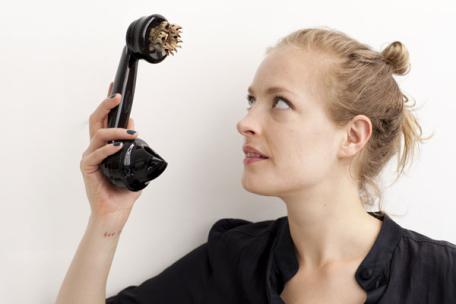
Five years ago Polly Morgan was working as a bar maid today she is one of the most important and collectible Young British Artists. She has been lauded by Gagosian director Mollie Dent-Brocklehurst, Damien Hirst and Saatchi to name but a few. She owes the transformation to a life long fascination with the craft of the taxidermist. It wasn’t until 2005 when she had lost her job that she thought of actually skinning an animal and a piece she did that year was bought for £2,000 by Richard Branson’s sister Vanessa. The piece consisted of a white rat curled up in a champagne glass and it was purchased hours before it was due to be exhibited at Zoo Art Fair.
Today her pieces can go from anything from £8,000 to £30,000. Her largest piece to date went for a staggering £85,000. Modeled on a Victorian flying machine the piece consists of starlings, Pigeons Canaries and three huge white backed Vultures all in flight and strapped to a circular frame.
When Morgan first started out, she would trawl pet shops, wildlife parks and farms to keep up a regular supply. She’d also drive up to a big bird fair in Stafford where she’d offer stall-holders £5 for every bird that died. She has now built up a wide circle of suppliers as the crows heads and wings in her freezer can testify to. “I describe my craft as part butchery, part sculpture.” she says. “There is a general distinction between male and female taxidermists,” Morgan observes. “Men tend to favour big, robust creatures. These are less interesting to me; I’m drawn to the delicate and fragile.”
She had graduated in English from Mary’s University. She hated University and afterwords couldn’t settle. “I was running the Electric Showroom bar in Shoreditch, where the Young British Artists would hang out; I was constantly surrounded by these artistic people who were doing really well,” One evening she asked a friend in the bar where she could acquire a piece of taxidermy to furnish her flat. The friend suggested that she do it herself and after some research she was ready to give it a go. She had tracked down a taxidermist who was willing to give lessons. “For £150, I’d get a day’s tutorial and get to keep the bird at the end of it; it was even cheaper than buying one,” she says
The rest is history.
